Sustainability

Environmental sustainability of the production process
SCROLL

Sustainability is an increasingly recurring subject that takes on a fundamental importance within the production reality of Conceria Stefania. We heard about ‘sustainability’ in 1972 during the first Conference on the Environment of the United Nation.
With this term we want to indicate a development system able to receive and fill the current needs, without compromising those of the future generations.

The need arises from the awareness that, what our planet offers us is not unlimited, and for these reasons we must preserve, respect it and take care of the different ecosystems. As a result, all this has been reflected in the need to create a “sustainable development”, leading, as a logical consequence, to the rational exploitation of the resources, the control and reduction of the waste and the use of production processes with reduced environmental impact.


SUSTAINABILITY AND LEATHER
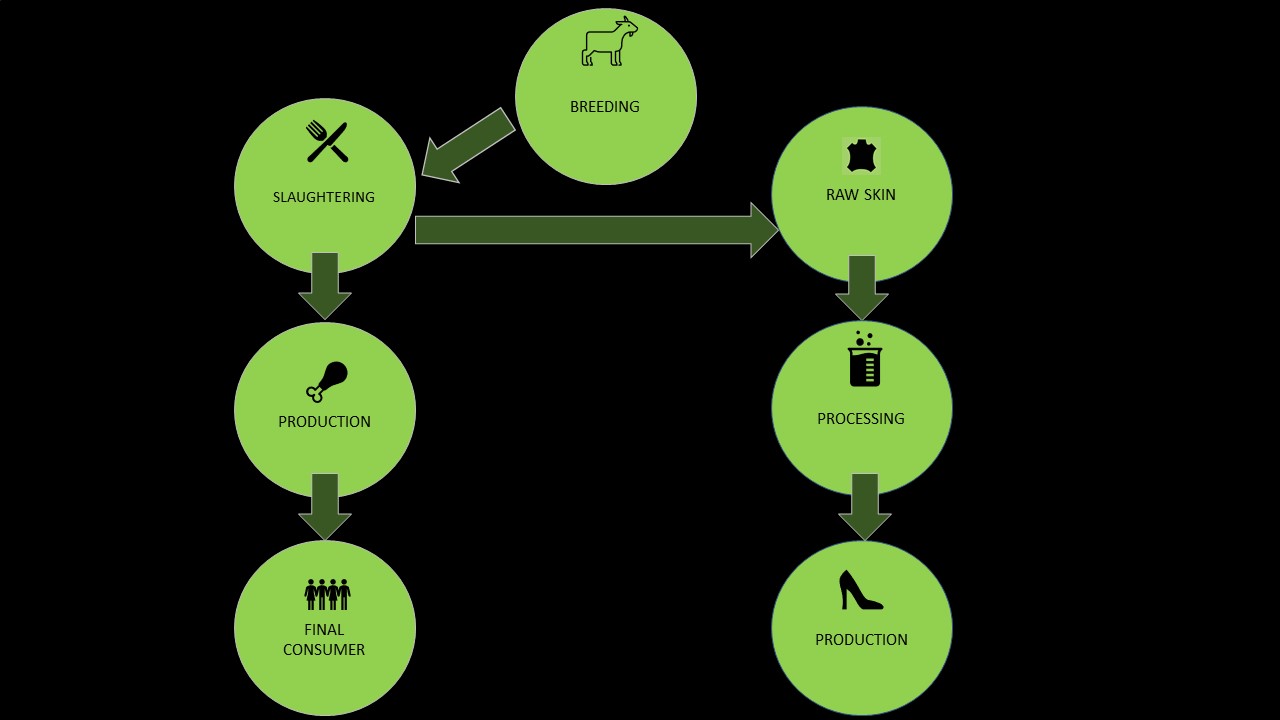
Conceria Stefania carries out all the processing on leather, which comes from the by-products of the food industry and if it were not ennobled, should be lost and disposed.

Since 1944 our company has focused on the development of manufacturing qualities, the growth of artisan expertise supported by new industrial technologies, constantly adapting itself to the Green needs of the market.

Environment and renewable sources

In Conceria Stefania S.p.A. tradition and innovative technologies are combined as to always continue to provide a finished product of the highest quality, in line with the absence of substances dangerous to health and the environment, defined in the National and European Legislative Standards.


The leather processings, performed in the tannery, take into account the environment under all the aspects: consumptions and water drains, emissions in the atmosphere and consumption of chemicals to reduce the environmental impact by decreasing the quantities of solid, liquid and gaseous emissions by minimizing the waste of natural resources.

At all stages of the processing of the Wet Department (retanning and dyeing) the greatest attention is paid to the exhaustion of baths, to limit the consumption of chemicals and reduce the amount of waste produced (lower consumption of water and less production of redundant sludge).


In all the processes of the Finishing Department the choice has been the one to use chemicals, mostly water-based chemicals for years, in order to reduce or minimize the wastes of solvents in emission.
The control systems incorporated on our spraying plants allow to recognize the passage of the skin by opening the guns for the strictly necessary time. The old guns are being replaced with new ones that have a very high transfer power and reduce the consumption of chemicals relative to the treated leather surface.


In all the production departments we adopt a policy for the maintenance and cleaning of the machinery in order to limit the use of water for the simple washing operations.
In the Wet department the planning of the processes is carried out as to reduce the water consumption for the washing operations, for example: some machines are dedicated to the same color and, in case of color change, we plan the transition from lighter hues to darker hues.


Especially in the case of water used in the production process, a modern biological plant with active sludge has the task of purifying it. The biological treatment compared to the physical – chemical one allows to reduce the production of sludge with equal characteristics of the waste to be treated.

The plant is internal to the company and has been further improved during 2020 with the addition of a tertiary treatment section.

The current efficiency of the waste treatment plant is such as to respect the limit values for emissions into surface water (Legislative Decree 152/06 – Part 3 – Annex 5.).

The water treated by the same waste-treatment plant is partly used for some cleaning operations.

Respect for nature and extreme attention to environmental issues have always played a fundamental role in our company policy. A path started several years ago, to which today we are adding new goals that confirm and consolidate the company’s conduct towards environmental issues and sustainable development.

Since January 2020 we have chosen to use 100% energy from renewable sources (Download the certificate). We have selected and introduced materials composed of recycled and consequently recyclable raw materials, to be used in the packaging/packaging of finished leathers.

Conceria Stefania makes use of separate collection of waste for the management of the wastes such as PLASTIC, PAPER, GLASS and MIXED WASTE according to the current rules of the municipality where it is located. The correct disposal of the separate collection of waste leads to the recycling of differentiable waste with the advantage of the recovery of raw materials and energy and less final product intended for disposal.
In Conceria Stefania, electric charging stations have also been installed that allow you to recharge an electric vehicle.


Co2 Reduction

Conceria Stefania‘s commitment to the environment also extends to the reduction of CO2, which is inevitably generated in the production cycle of the leather industry. Conceria Stefania in 2015 planted a plot of land of:

39,800 m2 with 5912 native plants of the Ticino valley (4655 trees and 1257 shrubs) in Inveruno (MI), which takes the name of: ” bosco dei Galletti“.

Planting trees is the only way to reduce and eliminate the CO2 that is in the atmosphere.

TYPES OF PLANTS “BOSCO DEI GALLETTI”

Click to open

CO2 FOREST SINKS

Click to open

Certifications

UNI EN 16484:2015 “Leather – Requirements for the determination of the origin of leather production”

Certification that defines the requirements that are necessary to confer the origin of leather production based on the principle of the last substantial transformation according to Non-Preferential Rules of Origin.

TS SC 410 (traceability of raw materials for a “product system”)

It is a tool aimed at verifying the traceability of incoming raw materials (skins): origin, slaughterhouse, breeding / growth. The traceability of the hides upstream of the tannery / rough maker is mapped for the search for transparency required by the market.

LWG (Leather Working Group)

The LWG (Leather Working Group) audit protocol is a tool for assessing the environmental performance of leather goods manufacturers (brands, manufacturers, suppliers, end users) around the world.
It certifies the effort towards ecological production and systemic management of Quality, Environment, Safety and Ethics, as required by market needs.

Raw materials

The Use of raw materials that are completely recycled and recyclable, compliant with current regulations and not harmful to health.

Clean energy

The energy used by Conceria Stefania comes from 100% renewable sources.

Recycled paper

Conceria Stefania uses 100% TRENDWHITE recycled paper, distinguished by the “blue angel” environmental label,  certified by the supplier Andromeda Office.

Environmental labelling

Click to open